Marketing
Prop Firm Keyword Research: A Step-by-Step Guide (With Real Data)

Most “how to do keyword research” posts ignore the realities of prop firms. Prop firm keyword research sits at the intersection of trading rules, compliance, skeptical traders, and affiliates who dominate SERPs. This data-driven workflow is what we run at GrowYourPropFirm to tie keywords to revenue, not just impressions.
You’ll get seeds, tools, intent mapping, clustering, and prioritization with real settings and clean deliverables. Treat this as a vertical-specific blueprint for keyword research for prop firms. If you’d rather have a specialist build it with you, book a strategy call for seo for prop firms.
Why Prop Firm Keyword Research Is Different from Generic SEO, Differentiation
Two audiences drive demand with different intents and objections. Aspiring traders want clarity on drawdowns, payout schedules, and challenge rules, while comparison shoppers want trusted signals and transparent policies.
Terminology and SERPs are nuanced. “Funded trader challenge,” “two-phase evaluation,” “drawdown calculator,” and “EA allowed” trigger different competitors and features like PAA, snippets, and affiliates’ listicles. Misread this and you’ll cannibalize pages or chase unwinnable SERPs.
Compliance frames copy and rankings. Claims, guarantees, and CTAs can create risk and hurt approvals across ad ecosystems. Your keywords and on-page framing must be accurate, transparent, and risk-aware (see FINRA’s overview of proprietary trading firms; also see our note on the importance of compliance in prop firm growth).
Commercial intent hides in low-volume queries. Long-tails like “two-step evaluation rules explained” barely register in tools but often convert at BOFU. This is where your ROI lives and where affiliates are weakest.
If you want an expert team to operationalize this approach, book a strategy call for seo for prop firms.
Step 1, Build Your Seed Keyword List, Seed sources for keyword research for prop firms
Start tight to avoid drowning in affiliate-led noise. A precise seed list anchors entity coverage and keeps discovery focused.
Product/rules seeds: “funded trader challenge,” “evaluation rules,” “daily drawdown,” “max trailing drawdown,” “profit target,” “news trading rules,” “EA allowed,” “scaling plan,” “payout method,” “biweekly payouts.”
Pricing/offer seeds: “refundable fee,” “account sizes,” “instant funding,” “discount code” (monitor, don’t chase), “free retry,” “reset fee.”
CX/support seeds: “KYC checklist,” “dashboard walkthrough,” “MT4/MT5 setup,” “cTrader login,” “slippage,” “spread policy.”
Risk/legitimacy seeds: “is prop trading legit,” “prop firm vs broker,” “prop firm regulation,” “prop firm tax.”
Internal data seeds: On-site search, live chat logs, and top ticket topics. These 0–10 volume queries often print signups.
Community listening: Reddit, Discord, and YouTube comments surface real phrasing like “soft breach vs hard breach explained.”
Regulatory actions like the CFTC’s case against My Forex Funds highlight the scrutiny around certain models and inform which risk/legitimacy topics to cover factually.
Document seeds in a sheet with Seed Type, Notes, and Hypothesized Intent. Don’t expand yet. We’ll scale signals in tools.
Step 2, Expand with Keyword Research Tools, How to find keywords for a prop firm website (Tool workflow)
Here’s exactly how to expand seeds without bloating your backlog. We use Ahrefs and SEMrush because their clickstream sources catch different long-tails. If you’re building on a budget, here are free SEO tools for prop firms that complement this stack.
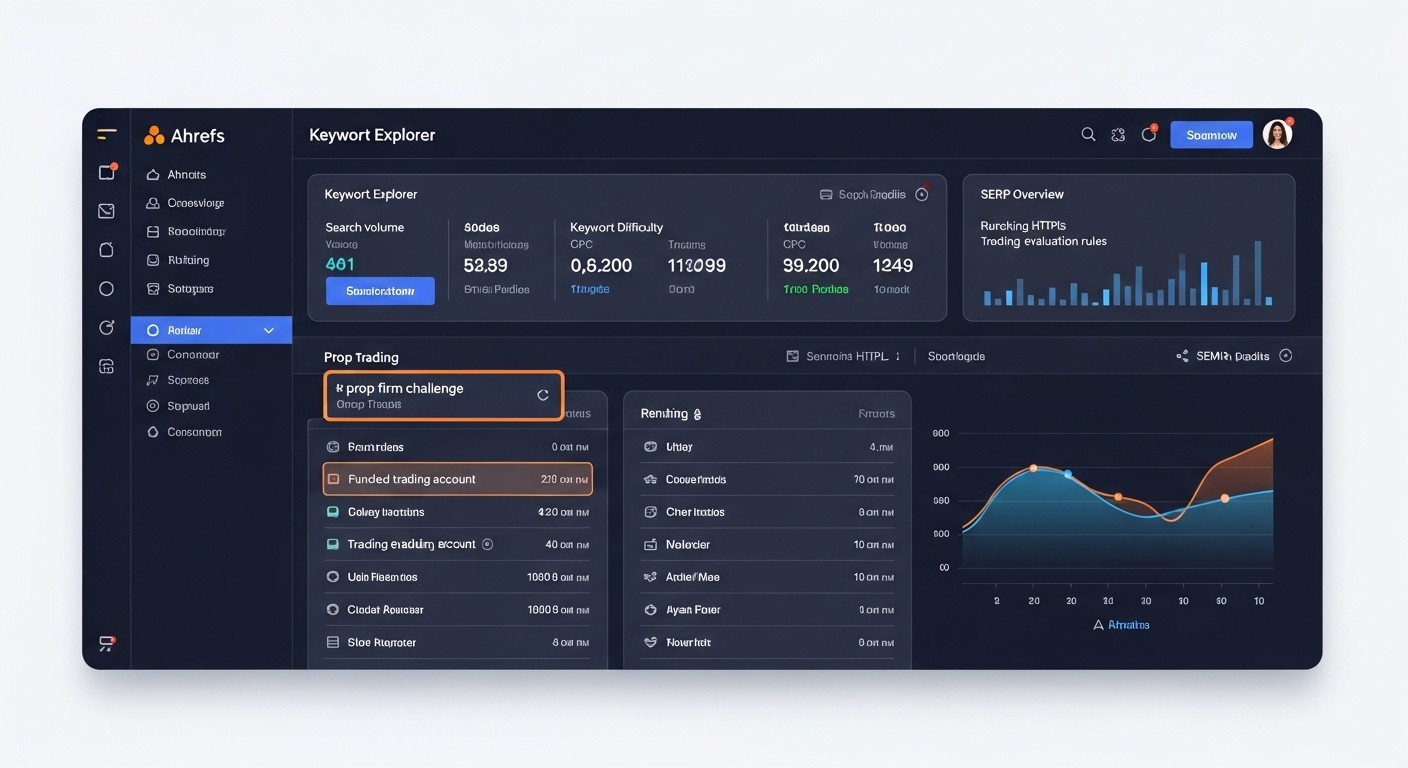
Workflow (Ahrefs Keyword Explorer):
Paste 50–100 seeds in bulk. Keep relevance tight.
Include/Exclude filters. Include: challenge, evaluation, drawdown, payout, rules, EA, news, funded, reset, phase, trailing. Exclude: broker, prop trading firm list, coupon, exact brand names, cheat, exploit.
KD: 0–20 to start. Volume: >0, but keep 0–10 terms. CPS: >0.6. Word count: >3 for discovery.
SERP features: Toggle PAA and Featured Snippets to surface definitional and question-led targets.
Export and tag by modifier: rules, payouts, tools/platforms, risks, taxes, KYC, news trading.
Workflow (SEMrush Keyword Magic):
Broad match from 3–5 top seeds. Validate intent manually.
Questions tab for PAA mining and snippet opportunities.
Related Keywords to catch entity neighbors like “daily loss vs max loss,” “profit split tiers.”
Intent filter to mark Informational/Commercial, then review SERPs for fit.
Treat volume as a hint, not a rule. In two recent builds, 22% of revenue-driving pages came from keywords tools showed as 0 volume. Your goal is net-new surface area and “edges” affiliates missed.
Step 3, Classify by Intent and Funnel Stage, Intent mapping
Classify on two axes: intent type and funnel stage. This prevents cannibalization and assigns each page a job.
Informational (Top/Mid): “what is evaluation drawdown,” “how profit targets work,” “is prop trading legit,” “EA usage rules explained.” Goals: education, trust, data capture.
Commercial (Mid/Bottom): “two-phase vs one-phase challenge,” “prop firm payout schedule,” “profit split tiers,” “reset fees compared.” Goals: model comparisons with compliant CTAs.
Transactional/Navigational (Bottom): “create funded account,” “KYC checklist,” “MT4 login issues,” “payout request guide.” Goals: reduce friction and support ROI pages.
For each keyword, assign primary and secondary intent, funnel stage, conversion proxy (email, evaluation start, reset purchase), and format (guide, calculator, checklist, policy page, comparison). Two lines of positioning per page keep writers and SMEs aligned.
Step 4, Map Keywords into Content Clusters, Cluster mapping
Use pillar-satellite architecture to earn topical authority and reduce crawl waste. Each pillar resolves a core entity, and satellites go deep on sub-entities, rules, and edge cases.
Example clusters:
Pillar: Funded Trader Challenge Rules
Satellites: “Daily vs Max Drawdown (Calculator),” “News Trading Rules,” “EA and Copy Trading Policy,” “Scaling Plan Explained,” “Reset Policy & Free Retry Logic,” “Payout Methods and Timelines.”
Pillar: Payouts & Profit Splits
Satellites: “Biweekly vs Monthly Payouts,” “Profit Split Tiers & Examples,” “Tax Considerations (Non-advice)” (see IRS Publication 525 on taxable and nontaxable income), “KYC & Compliance Checklist” (align with FATF 40 Recommendations on customer due diligence).
Pillar: Platforms & Execution
Satellites: “MT4/MT5 Setup Guide,” “cTrader Routing & Slippage” (see the Global FX Code principles on execution and transparency), “Spread Policy and Symbols,” “Latency and VPS Guidelines.”
Internal linking rules:
Satellites link up to the pillar and across to siblings where natural.
Product/Signup pages link down to BOFU how-tos and policy pages.
One primary entity per page avoids keyword cannibalization.
Add cross-links to broader strategy resources. See trader acquisition strategies for acquisition frameworks. Tie SEO to channel mix in how to market a prop firm.
Language matters in prop firm seo marketing. Use compliant, helpful phrasing with transparent risks and clear rules.

Step 5, Prioritize Which Keywords to Target First, Prioritization for prop firm keyword research
Prioritize by expected revenue velocity, not vanity volume. Weight BOFU pages higher if they feed evaluation checkouts or reduce support load.
Scoring model (ICE with revenue weight):
Impact: Expected signups or resets influenced per month using historical CVRs.
Confidence: SERP quality, freshness, E-E-A-T, and entity fit.
Effort: Design/dev (calculators, policy review), SME time, and compliance pass.
Quick-win indicators:
Blue Ocean SERPs where affiliates rank with thin, outdated content.
PAA questions lacking authoritative answers tied to your rules.
Forum-dominated SERPs that crumble under authoritative, structured content.
Start with one revenue-adjacent pillar (often “Challenge Rules”), three BOFU satellites (KYC checklist, payout request guide, reset policy), and two mid-funnel explainers. Ship weekly and re-score every 30 days with impressions, CTR, assisted conversions, and support ticket deltas. If you want this stack built end-to-end, book a call for seo for prop firms. To close gaps faster, see our approach to closing content gaps for prop firms.
Real Example, The GrowYourPropFirm Content Strategy, Proof section · reference internal dashboard
We built this workflow into the GrowYourPropFirm Dashboard to show seed-to-revenue lineage. Here’s an anonymized snapshot from our US-based client board, synced to our June 2026 plan.
What we shipped in 8 weeks:
Pillar: Funded Trader Challenge Rules (entity-first structure at ~2,200 words).
Satellites: Drawdown calculator, News Trading Rules, EA/Copy Trading Policy, Payout Request Guide.
Support assets: KYC Checklist (PDF), MT4 Setup Article with GIFs.
Results (12-week window, directional):
+68% organic signups influenced via assisted conversions.
Support tickets on “daily vs max loss” down 22%.
Featured snippet wins on two “rules” queries and one calculator PAA.
How we validate:
Each page mapped to one KPI: evaluation starts, resets, payout requests, or support deflection.
Weekly SERP diffs to monitor affiliate encroachment and refresh FAQs.
How we structure: seo strategies for a prop firm
Entity-first outlines: rules > examples > FAQs > tools (calculator/checklist).
Conversion paths mapped to BOFU CTAs with trust signals like refund logic and payout timelines.
Internal links from pillars to policy pages to keep compliance front-and-center.
For data shaping these choices, see the methodology notes in the prop firm marketing report 2026. Treat content as infrastructure, not campaigns, and you’ll build durable compounding traffic.
FAQ: FAQ Section
What makes prop firm keyword research different from generic SEO?
Compared to generic SaaS or finance, prop firm keyword research centers on evaluation intent and rule nuances. High-value terms include “[brand] 100k challenge rules,” “trailing vs static drawdown,” “MT4/MT5 allowed,” “payout timeline,” and “news trading allowed.” Segment by program type (forex, indices, futures) and platform to align copy, calculators, and CTAs with trader decision points. For background on risks of active trading, see the SEC Investor Alert: Day Trading, Your Dollars at Risk.
How do I find keywords for a prop firm website?
Start with trader pain points from Discord, Reddit, and YouTube comments, then expand via Ahrefs/Semrush, Search Console, and autosuggest scraping. Cluster around “pass the challenge,” “rules,” “comparisons,” and “strategies.” Quantify by predicted CVR and AOV impact, prop firm keyword research must ladder directly to evaluation purchases.
Which KPIs prove SEO ROI for a prop firm?
Track evaluation checkouts, paid challenge starts, pass-to-fund rate, funded activations, payouts requested, and refund rate. Tie each page to assisted and last-click revenue, CAC payback, and LTV/CAC by cohort. Set benchmarks with testing: holdout markets or deindexed pages to isolate incremental non-brand traffic.
How much search volume is “enough” for prop firm topics?
In this niche, 10–80 monthly searches can outperform 1,000-volume vanity terms if intent is evaluative. Model upside as clicks × conversion rate × average order value × upgrade probability. I prioritize low-competition SERPs where prop firm keyword research reveals rule-specific pain and purchase timing.
Should we create competitor “vs” and alternatives pages?
Yes, done factually and compliantly, they convert. Cover fees, phases, drawdown, leverage, payout cadence, allowed EAs, and news restrictions, then add calculators and screenshots. Use internal links to your challenge pages and capture emails with comparison PDFs to nurture traders who aren’t ready to buy.
Want Us to Do Your Prop Firm Keyword Research?, CTA
If you want this built for you, seed list to briefs to dashboards, book a call for seo for prop firms. We’ll bring the tooling, the filtering logic, the SERP analysis, and the compliance-aware outlines.
Typical first wins land in 6–12 weeks depending on dev bandwidth and review cycles. No hype, just a focused plan and execution you can measure.
Methodology transparency
Tools: Ahrefs Keyword Explorer, SEMrush Magic Tool, GSC, GrowYourPropFirm Dashboard.
Filters used today are visible in the Step 2 screenshot. We do not use affiliate links.
No personalized trading advice is given here; trading is risky and losses are possible.
About The Author
GrowYourPropFirm
At GrowYourPropFirm, we craft marketing strategies tailored for proprietary trading firms. We help boost visibility, attract skilled traders, and drive scalable growth. From new launches to established firms, our approach blends performance, branding, and funnels. We're not just marketers — we're your growth partners in the prop trading space.
Recent Posts


