Marketing
How to Market a Prop Firm in 2026: Channels, Strategies, and a 90-Day Plan

How to Market a Prop Firm in 2026, Channels, Strategies & 90-Day Plan
If you’re asking how to market a prop firm in 2026, you’re not alone. The space is maturing fast, policies are stricter, and traders are savvier about challenge structures, risk, and payouts. Playbooks that worked in 2022 no longer clear compliance or CAC thresholds, and “growth at any cost” now invites processor and platform risk.
I’ve led launches and turnarounds for multiple funded-trader programs. In this guide, I’ll show you what’s working now for prop firm marketing, what to avoid, and a 90-day plan you can run. This is practitioner-level execution focused on compliant demand capture, cohort LTV, and measurable ROI across channels.
Trading involves risk, and nothing here is financial advice. The goal is to build credible, transparent marketing for a legitimate evaluation and funding pathway, and to do it in a way that protects your brand, cash flow, and long-term merchant health.
Why Marketing a Prop Firm Is Different, Framing section
Most SaaS or ecom frameworks fail when applied to prop firm marketing. Your “product” is an evaluation with explicit rules and probabilities, monetized through a challenge fee. That changes your messaging, your risk profile, and how you measure attribution and LTV.
You are selling a pathway to potential funding, not income. Earnings claims trigger ad disapprovals, processor scrutiny, and reputational damage (see FINRA Rule 2210 communications standards). Copy must emphasize education, rules, and risk controls with clear disclaimers.
Your LTV curve is irregular. Revenue bunches around initial challenge fees, retries, and a subset of profit splits. Forecast CAC by segmenting cohorts by phase progression, pass rates, payout eligibility, and refund windows.
Trust is the conversion lever. Proof of payouts, transparent rules, stable platforms, and responsive support convert better than hype. Traders evaluate credibility in seconds, so show payout timelines, refund logic, and status updates in plain sight.
Fraud and compliance pressure are real. Recent actions like the CFTC enforcement action against My Forex Funds show how aggressively regulators scrutinize misleading practices. Processors watch chargeback spikes and misleading claims, and affiliates can create complaints if unmanaged. Organic growth requires topical authority across intents from “what is a prop firm?” to “two-phase vs one-phase pros and cons,” and your entity signals must be consistent.
Ad platforms classify you as financial services. That means stricter approvals, creative guardrails, and regional constraints. Winning comes from crisp positioning, policy-safe creative, reliable tracking, and documented evidence that your evaluation model is fair, well-run, and supported by clear policies (see the Google Ads Financial Products and Services policy).
The 5 Marketing Channels That Work for Prop Firms, The best marketing strategies for prop firms (how to market a prop firm)
There isn’t one silver bullet. The best marketing strategies for prop firms sequence five channels by time-to-value and risk to stabilize CAC and compound reach. Your mix should reduce affiliate dependency, protect paid delivery, and build durable organic demand.
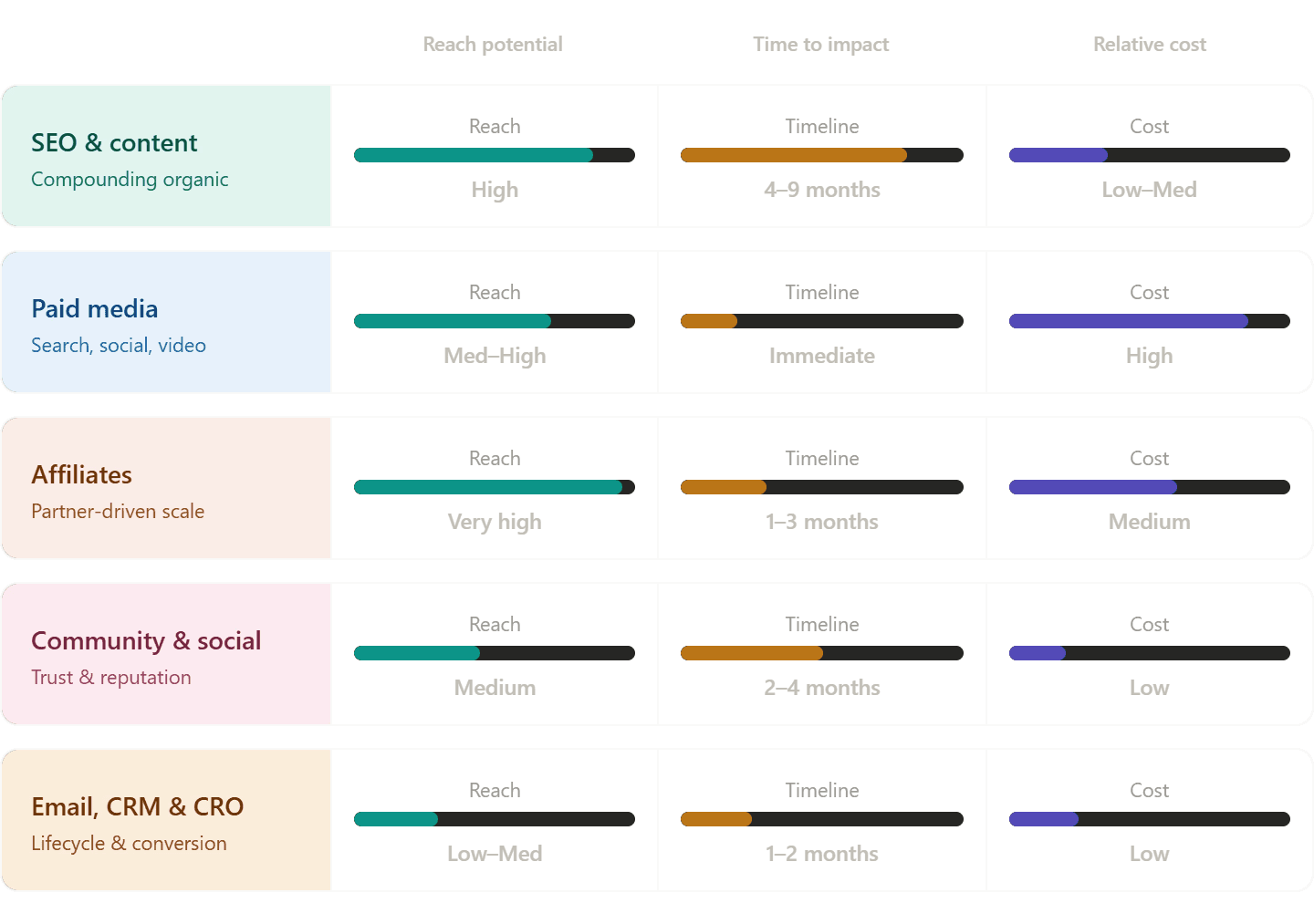
Timeline shorthand:
Fast: paid search, high-intent YouTube, top-tier affiliates
Medium: community, lifecycle/email, CRO
Compounding: SEO, entity and reputation building
1) SEO and Content: Own Trader Intent, Build Credibility
SEO is your compounding engine for organic trader signups. Think evaluation, decision, and comparison intent, and build clustered content around rules and challenge design. For a deeper playbook, see our SEO for prop trading firms guide.
Cover evaluation queries like “two-phase challenge rules,” “maximum drawdown explained,” and “free retry terms.”
Launch product-led assets: drawdown calculators, rule simulators, payout timelines, dashboards, and transparent FAQs.
Strengthen entity signals with founder bios, policy pages, and consistent data across site, socials, and review platforms.
2) Paid Media: High-Intent First, Creative That Clears Compliance
Start with search and YouTube where intent is explicit. Expand to Meta and TikTok only after you have policy-safe creative and pre-approvals. Anchor messaging in rules, timelines, risk disclosures, and education.
Build funnels by intent with exact-match search and 60–90 second YouTube explainers.
Retarget with feature-led creative and testimonials that emphasize process, not earnings.
Maintain a creative library with do/don’ts to prevent compliance drift.
3) Affiliates: Scalable Reach, Strong Guardrails
Affiliates can unlock reach fast, but unmanaged claims can tank Trustpilot and processor health. Structure tiered commissions tied to refund windows and payout-qualified cohorts. For frameworks, see our affiliate program strategy.
Enforce a claims policy, provide a compliance kit, and pre-approve assets (align with the FTC’s Endorsement Guides).
Lock UTMs and whitelisted coupons to protect attribution.
Prune partners who trigger chargebacks or complaints even if their volume looks good.
4) Community and Social: Proof and Transparency in Public
Discord, X, Reddit, and YouTube Shorts are where traders vet you. Stream aggregated payout stats, publish maintenance calendars, and address incidents quickly. Strong reputation signals compound across channels; see our reputation management for prop firms guide.
Run AMAs on rule clarifications and platform updates.
Share trader education over hype, and turn tough questions into content.
Good community management improves conversion from all channels and lowers paid CAC.
5) Email, CRM, and CRO: Nurture to Conversion and Repeat
Your CRM holds under-monetized intent. Build lifecycle programs around evaluation stages and pair them with CRO that removes friction.
Cart abandonment flows for challenge fees with compliant nudges.
“Stalled in phase one?” sequences with rule tips and retry options.
On-page clarity for rules, refunds, and payouts, plus eligibility checkers and calculators.
SEO for Prop Firms, Building an Organic Trader Acquisition Engine
SEO is not just blogs. It’s structured information architecture, rules clarity, and proof that your program is legitimate. Winners in 2026 pair entity strength with intent-led content and frictionless UX, which directly supports how to market a prop firm at scale.
Map Search Intent to Your Challenge Structure
BOFU pages: dedicated, indexable pages for each challenge and phase with tables for drawdown rules, daily loss limits, and retry logic. Include clear CTAs that restate risk.
MOFU clusters: “How payouts work,” “Evaluation vs one-step funding,” “Scaling plans explained,” and “Trader dashboards walkthrough.”
TOFU guides: “What is a prop trading firm?” and “Risk management 101,” each with explicit disclaimers and internal links to BOFU pages.
Each page should include:
Prominent risk disclosures, refund conditions, and payout timelines.
Embedded calculators for daily loss headroom, max lot size by rule, and profit target estimates.
Real support SLAs, a status page link, and Trustpilot aggregates with structured data where policy allows.
Build Topical Authority and Entity Signals
Publish a rules change log with dates and reasons for changes. This is high EEAT.
Create author pages for risk managers and product leads with bios and LinkedIn links.
Align brand, founders, and company profiles across site, socials, and review platforms with consistent NAP and ownership details.
Boost SERP visibility with:
Schema: FAQPage on rules pages, HowTo for “How to request a payout,” and Product for challenge SKUs. Follow Google’s structured data guidelines.
Review integration that matches third-party data. Never fabricate ratings or reviews.
Technical and Global Foundations
Core Web Vitals: optimize LCP and CLS on pricing and challenge pages, especially rule tables on mobile.
Internationalization: implement hreflang, localize currency and payment options by GEO, and clarify region eligibility.
Crawl control: link internal FAQs, manage sitemaps for dynamic pages, and run periodic log-file checks to remove crawl traps.
Measure What Matters
Track organic conversion events: challenge purchase, evaluation start, and funded status.
Attribute assisted conversions across retargeting and paid social to credit SEO properly.
Tie content clusters to challenge fees and downstream payouts to estimate lifetime value created by informational content.
Want this built for you end-to-end? Explore our prop firm seo services for entity optimization, rule-based content systems, and analytics that connect rankings to funded accounts.
Paid Advertising for Prop Firms, Compliance-First Performance
Paid media scales quickly when you sequence channels, engineer clean attribution, and build creative that passes policy. Think “explain the product, prove the process,” not promises. This is where prop firm advertising must balance ROAS and approval stability.
Start with Intent, Then Educate
Google Search: exact and phrase match around “buy challenge,” “prop trading challenge,” “funded trader program,” and protect brand terms. Exclude misleading queries such as “guaranteed income.”
YouTube: 60–90 second explainers on evaluation phases, drawdown, and payout timelines with sitelinks to rules and refund policies.
Meta/TikTok: expand only after creative and landing pages are pre-cleared. Use story-led dashboards, rules overlays, and education snippets with on-screen disclaimers.
Engineer Attribution and Safeguards
Deploy server-side tracking and Conversion API. Fire standardized events for view rules, add challenge, purchase, evaluation start, and funded status.
Implement a creative pre-approval workflow and maintain a policy-noted asset library. Archive borderline ads quickly.
Segment GEOs by processor risk and platform restrictions. Align currency, payment options, and eligibility in ad-to-landing flows.
Offers, Messaging, and CAC Control
Offer frameworks: modest first-challenge incentives, education bundles, or “retry assurance” where policy allows. Avoid quoting pass rates unless substantiated and contextualized.
Creative angles: “Know your rules before you risk,” “Transparent payouts with clear timelines,” and “Two-phase or one-phase, choose your path.”
Budget pacing: front-load into search and YouTube, build retargeting pools, then scale social cautiously. Defend branded CPCs to reduce affiliate cannibalization.
Need a compliant growth plan executed end-to-end? Our prop firm paid media services specialize in policy-safe creative, robust tracking, and CAC reduction without affiliate overreliance.
Affiliate Marketing, The Double-Edged Sword
Affiliates can drive 30–60% of volume for some firms, but unmanaged hype creates refunds, chargebacks, and platform risk. Treat affiliates like a portfolio you optimize, not a savior you depend on.
Structure: tiered commissions with holdbacks through refund windows and bonuses tied to payout-qualified cohorts. Pay for quality, not just volume.
Compliance: provide a claims policy, approved copy, risk disclaimers, and creative examples. Ban “guaranteed funding,” income promises, and unrealistic pass rates (align with the FTC’s Endorsement Guides).
Attribution: enforce UTM hygiene, whitelisted coupon codes, and last-click rules to avoid cannibalizing paid and organic.
Risk controls to protect brand and processors:
Run root-cause analysis on spikes in chargebacks or Trustpilot dips by affiliate (see Mastercard’s Excessive Chargeback Program).
Sunset non-compliant partners fast and document warnings. Your reputation is worth more than short-term revenue.
Rotate tests with micro-influencers who teach rules and risk, not payouts and hype.
Your 90-Day Prop Firm Marketing Plan, How to market a prop firm fast
Use this action framework to launch or stabilize CAC quickly. It’s sequenced for speed, compliance, and compounding gains and is formatted for easy sharing and featured snippet extraction.
Define positioning (Days 1–3)
Clarify evaluation model, refund eligibility, payout timelines, and GEO coverage.
Write a one-pager: who you fund, why your rules are fair, what support traders get.
Build a compliance kit (Days 1–7)
Create a claims policy, risk disclaimers, and an “approved copy” doc for ads and affiliates.
Compile a creative library with do/don’ts and pre-submit key pages to platforms.
Implement analytics and events (Days 1–10)
Set up server-side tracking, CAPI, and events for view rules, add challenge, purchase, evaluation start, and funded.
Create dashboards for refund-adjusted CAC and ROAS by channel.
Ship site fixes that move conversion (Days 1–14)
Add rule tables, a payout timeline page, and clear refund policy UX.
Publish a status page, support SLAs, and Trustpilot widgets.
Launch BOFU SEO assets (Days 7–21)
Publish challenge pages per phase and “How payouts work” with FAQ schema.
Add drawdown and daily loss calculators and link them sitewide.
Turn on intent-first ads (Days 10–21)
Activate Google Search and YouTube explainers with policy-safe scripts.
Retarget visitors with rule-led creative and on-page disclaimers.
Run an affiliate pilot with guardrails (Days 14–28)
Onboard 10–20 vetted partners with a compliance kit and whitelisted coupons.
Audit weekly for refunds, chargebacks, and complaint volume.
Kickstart community (Days 14–30)
Launch Discord with clear rules and weekly AMAs.
Share anonymized payout aggregates, maintenance calendars, and incident reports.
Execute CRO sprints (Days 21–45)
Test pricing table clarity, “retry assurance” messaging, and rule-first CTAs.
Launch cart abandonment and “stalled in phase one?” lifecycle sequences.
Scale proven segments (Days 31–60)
Expand search terms and YouTube audiences seeded from funded cohorts.
Double down on compliant affiliates and cut underperformers.
Publish MOFU content (Days 31–60)
Ship comparisons (one-phase vs two-phase), rule deep dives, and platform guides.
Add author bios for risk and product leaders and link to their profiles.
Build a social system (Days 31–60)
Post weekly payout process updates and monthly rule explainers.
Turn consistent questions into Shorts and FAQs.
Localize for top GEOs (Days 45–75)
Translate key pages, localize currency and processors, and set hreflang.
Mirror ad account structure by region for policy and pacing.
Run a policy health check (Days 60–75)
Review every live ad and landing for drift and archive edge cases.
Refresh disclaimers and sync messages across site, ads, and affiliates.
Optimize for LTV (Days 60–90)
Build funded-trader onboarding to improve longevity and referrals.
Create win-back flows for failed evaluations with rule education offers.
Want this executed by specialists who’ve managed $25M+ in prop media with refund-adjusted CAC targets? Start with an audit or book a call, or compare partners in our guide to best prop firm marketing agencies.
Frequently Asked Questions
What’s the most cost‑effective channel mix to acquire funded traders in 2026?
Aim for a blended MER of 2–3x with CAC capped at 25–35% of initial challenge revenue. In practice, let paid search capture high intent, use paid social for scale, deploy affiliates under capped CPA or rev share, and fund SEO as OPEX. Start roughly 30–40% search, 30–40% social, 10–20% affiliates, and rebalance weekly to CAC:LTV.
How can we run prop firm advertising on Google, Meta, and TikTok without policy issues?
Use a compliance-first framework with no earnings claims and clear risk disclosures on creatives and landing pages. Emphasize rules, timelines, evaluation structure, and simulated nature where applicable. Apply GEO and age filters, deploy Conversion API, and pre-clear pages with platform policy teams. Maintain a labeled creative library and structured tests to protect delivery.
Which SEO content actually converts traders for prop firms?
High-intent BOFU wins: challenge rules explainers, max daily loss and trailing drawdown calculators, payout schedule pages, and honest “YourBrand vs Competitor” comparisons. Add funded-trader case studies with verifiable criteria, HowTo schema for “How evaluations work,” and GEO landing pages tied to eligible regions. Track rank-to-application CVR and target 2–4% as a baseline.
What KPIs matter most for scaling a prop firm’s marketing profitably?
Measure full funnel: CPC and CPL to challenge purchase rate, refund rate inside seven days, pass rate by day 30, and funded-to-payout ratio. Hold CAC:LTV at 1:3+ on a 90-day net LTV basis after processor fees and payouts. Operationally, monitor rule-violation churn and support SLAs. Reconcile channel-level attribution to cash and chargebacks monthly.
What’s a 90‑day plan to go from zero to consistent trader applications?
Start with a two-week audit and funnel fixes, then launch intent search and YouTube while spinning up three compliant landers. In parallel, ship a 10–15 page SEO cluster and onboard vetted affiliates with tiered CPA caps. Scale weekly only when MER >2x, refund rate <10%, and pass-rate mix meets risk targets. Automate lifecycle email/SMS to lift conversion and retention.
Work with GrowYourPropFirm
I’m Derek Mendez. I care about ROAS, compliance, and credibility above hype, and I’ve managed millions for trading firms with refund-adjusted CAC targets. If you want a partner to execute this plan end-to-end, explore our prop firm seo services and prop firm paid media services, or compare options in best prop firm marketing agencies.
Ready to make prop firm marketing a durable growth engine? Book an audit, and let’s align CAC, LTV, and policy health in the first 30 days.
About The Author
GrowYourPropFirm
At GrowYourPropFirm, we craft marketing strategies tailored for proprietary trading firms. We help boost visibility, attract skilled traders, and drive scalable growth. From new launches to established firms, our approach blends performance, branding, and funnels. We're not just marketers — we're your growth partners in the prop trading space.
Recent Posts


