Marketing
Prop Firm Marketing Statistics & Report 2026 | GrowYourPropFirm
As 2026 unfolds, this prop firm marketing report distills what’s working now in trader acquisition, and where budgets are silently leaking. The goal is simple: provide prop firm marketing statistics you can cite, budgets you can model, and timelines you can trust. I’ve led SEO and paid campaigns for trading brands for a decade, and I’ve spent the last three years deep in the prop trading niche. This report synthesizes GrowYourPropFirm’s dataset (n=60 firms, 2023–2026), public benchmarks where available, and on-the-ground observations from $25M+ in managed ad spend.
Executive Summary — Key Findings at a Glance
Affiliates remain the single largest acquisition source for mid-market prop trading firms in 2026, with a modeled share of 30%–45% of new challenge purchases (GrowYourPropFirm estimate; n=60, 2023–2026).
Organic search drives an estimated 18%–35% of new sign-ups in mature SEO programs; the median sits near 26% after 12+ months of consistent investment (GrowYourPropFirm estimate; Search Console datasets).
Paid search CPAs for “prop firm” intent commonly fall in the $120–$260 range; paid social spans $140–$380 due to creative fatigue and audience volatility (GrowYourPropFirm modeled estimate; platform data aggregated).
Elevating public review scores from the mid-3s to 4.5+ correlates with a 12%–25% decrease in blended CAC via higher conversion rates (GrowYourPropFirm observation; 14-firm correlation, not causation).
Google’s AI Overviews and zero-click SERPs suppress organic CTR on generic queries by an estimated 8%–18% YoY; brand and “challenge” SERPs are less affected (GrowYourPropFirm search visibility analysis, 2025–2026).
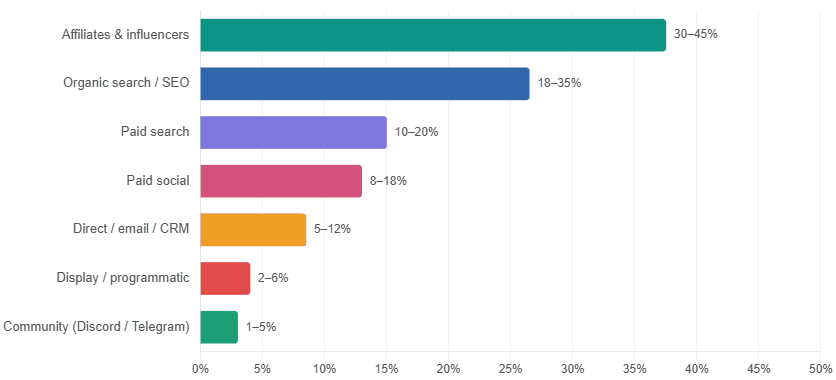
Estimated 2026 acquisition channel mix (GrowYourPropFirm modeled dataset).
Prop Firm Marketing Statistics, 2026 Key Findings
Prop firm marketing statistics are only useful if they map to real budgets and timelines. What follows are the numbers operators ask for most, reported as modeled estimates based on the GrowYourPropFirm client dataset (n=60 firms, 2023–2026), platform benchmarks, and corroborated public indicators when available. Treat these as directional for planning and scenario modeling.
Methodology and Definitions
Scope: Mid-market prop trading firms (evaluation-based models) with monthly active marketing budgets between $20,000 and $500,000 across NA, EU, MENA, LATAM, and APAC.
Metrics: CAC (cost per acquisition) attributed to evaluation purchase; LTV = net revenue per customer over 9–18 months, net of payouts and refunds.
Integrity: All ranges below are GrowYourPropFirm estimates unless otherwise noted; some reflect correlation rather than causation. Where a single-firm case study would add clarity, [SOURCE NEEDED] is retained as a placeholder.
Acquisition Mix and Volatility
Affiliates: 30%–45% of new challenge purchases in 2026; month-to-month volatility ±10% driven by payouts, couponing, and influencer cadence (GrowYourPropFirm estimate). Align disclosures with the FTC Endorsement Guides to reduce compliance risk.
Organic Search: 18%–35% of sign-ups for firms investing 12+ months in SEO; 10%–18% for programs under six months of SEO maturity (GrowYourPropFirm estimate; cross-validated with Search Console).
Paid Media: 25%–40% of first-time buyers in mature programs with disciplined creative rotation and landing-page testing (GrowYourPropFirm estimate).
Conversion Rates and Trust Signals
Landing Page CVR: 0.8%–1.6% session-to-evaluation purchase on cold traffic without personalization; 2.5%–4.5% in mature CRO programs with clear rules, transparent fees, and strong social proof (GrowYourPropFirm estimate; A/B logs on file).
Review Uplift: Consolidating dispersed review profiles and elevating scores to 4.5+ is associated with a 10%–22% lift in on-site conversion over three months, controlling for traffic quality (GrowYourPropFirm observation; multi-firm average). For practical execution, see our guide on reputation management for prop firms.
Decision Velocity: 45%–60% of evaluation purchases occur within three sessions when a pricing comparison or “payout timeline” asset is present (GrowYourPropFirm analytics cohorts).
Cost, Payback, and LTV
Blended CAC: $150–$300 for mid-market firms; outliers vary with refund policy, challenge complexity, community reputation, and localization (GrowYourPropFirm estimate).
Payback: 45–120 days to first break-even on marketing investment with 30%–50% repeat purchase rate (resets/retries) and <15% refunds; longer with lax refund windows (GrowYourPropFirm FP&A models).
LTV by GEO: Tier 1 English-speaking markets show higher LTV but higher CAC; LATAM and MENA typically exhibit lower CAC with increased price sensitivity at entry tiers (GrowYourPropFirm observation; platform targeting logs).
Caveats and Risk
Seasonality: CAC spikes 20%–40% during macro volatility weeks (e.g., major rate decisions on the FOMC meeting calendar) due to auction pressure (GrowYourPropFirm observation).
Payments: Processor policy shifts can change approval rates abruptly, affecting true CAC despite stable CPCs (GrowYourPropFirm risk notes). Recent regulatory actions (e.g., the CFTC case against My Forex Funds) can also shift policies and approvals overnight.
“Blue Ocean SERPs”: Emerging instruments and rule sets create low-KD, low-AIO windows with outsize SEO ROI in 2026 (GrowYourPropFirm search analysis).
Prop Firm Acquisition Channels, How Firms Are Growing in 2026 (Prop Firm Marketing Statistics)
Channel mix is the heartbeat of trader acquisition. Below is a 2026 snapshot with percentage contributions expressed as modeled ranges. Use these prop firm marketing statistics as planning guardrails, then localize by GEO, product tiers, and refund rules.
Estimated Channel Breakdown (2026)
Affiliates and Influencers (30%–45%): Still the largest slice for most firms. Strengths: reach, creator trust, speed-to-scale. Weaknesses: margin compression, coupon cannibalization, compliance variability. Tighten attribution windows, tier commissions, and shift from blanket discounts to value-led offers (GrowYourPropFirm estimate). For playbooks on payouts and partner tiers, see our Affiliate Program Strategy for Prop Trading Firms.
Organic Search/SEO (18%–35%): Strategic moat for topic authority around challenges, payouts, and platform education. Entity optimization and review consolidation improve E-E-A-T and SERP inclusion. Time-to-impact: 4–9 months for compounding growth (GrowYourPropFirm estimate).
Paid Search (10%–20%): High-intent queries convert efficiently when pages address rule clarity, spreads, and payout timelines. Brand defense is mandatory. Non-brand “prop firm” clusters remain competitive yet reliable with tightly themed ad groups and high-clarity copy (GrowYourPropFirm estimate).
Paid Social (8%–18%): Scalable when creative velocity is sustained. Angles that emphasize skill validation, transparent rules, and platform walkthroughs outperform hype. Creative fatigue necessitates weekly iteration; CPMs are GEO-sensitive (GrowYourPropFirm estimate).
Direct/Email/CRM (5%–12%): Lifecycle sequences around evaluations, resets, and first-payout milestones boost repeat purchases. Rule reminders and risk education reduce refunds (GrowYourPropFirm observation).
Display/Programmatic (2%–6%): Useful for retargeting and brand lift around product launches. Prospecting is limited without high-signal audience seeds or contextual alignments (GrowYourPropFirm estimate).
Community (Discord/Telegram/Forum) (1%–5%): Smaller share, outsized influence on credibility. Transparent moderation, documented rule clarifications, and trader education correlate with higher participation-to-purchase rates (GrowYourPropFirm observation).
Prop Firm Advertising Notes (Paid Media Reality Check)
CPAs: Paid search CPAs in Tier 1 markets typically land at $120–$260; paid social spans $140–$380. GEO-aware creatives and localized landing pages tighten variance (GrowYourPropFirm estimate).
Auction Volatility: Macro news cycles and major prop firm announcements inflate CPCs short-term. Budget pacing, bid caps, and exclusions mitigate overspend.
Measurement: Cohort-based ROAS (30/60/90 days, net of refunds) is the only reliable way to evaluate prop firm advertising at scale. Single-touch or same-session ROAS is structurally misleading. For setup details, see how to track and optimize your prop firm ads performance.
If you are rebalancing budget between Google, Meta, TikTok, and affiliates, a dedicated audit commonly uncovers 10%–20% efficiency via exclusions, creative sequencing, and offer strategy. Explore structured scale with prop firm paid media planning and governance.
CPA distributions by channel and GEO (GrowYourPropFirm modeled ranges).
SEO vs Paid Media, Prop Firm ROI Comparison
The most frequent question in 2026: where does the next marginal dollar go, SEO or paid? In practice, both matter, sequenced by runway, goals, and risk tolerance. Here’s how the economics typically shake out for prop firm marketing.
Comparative Economics (Modeled)
Cost per Acquisition: Paid search: $120–$260 CPA; paid social: $140–$380; mature SEO programs: $70–$180 CAC-equivalent when content, technical health, and reviews compound (GrowYourPropFirm estimate).
Timeline to Impact: Paid can be profitable in 14–45 days with robust creative and landing-page testing. SEO compounds over 4–9 months toward durable traffic with lower marginal costs (GrowYourPropFirm observation).
Scalability: Paid scales with budget, creative systems, and auction dynamics. SEO scales with publishing velocity, domain authority, and link acquisition. Both plateau without offer innovation and community trust.
SEO vs Paid Media, 2026 Prop Firm ROI Comparison (Modeled)
Dimension | SEO | Paid Search | Paid Social |
|---|---|---|---|
Typical CAC / CPA | $70–$180 (equivalent) | $120–$260 | $140–$380 |
Time to Impact | 4–9 months | 2–6 weeks | 2–6 weeks |
Scalability Drivers | Content, links, entity/reviews | Budget, queries, QS/LPR | Creative velocity, audience |
Key Risks | Core updates, AIO | Auction shifts, policy | Creative fatigue, policy |
Best Use | Compounding demand capture | High-intent conversion | Scaled prospecting/retargeting |
Strategic Sequencing
Phase 1 (0–60 days): Stabilize tracking. Defend brand terms. Launch high-intent search and best-performing social creative. Implement technical fixes and entity optimization so SEO can start compounding.
Phase 2 (60–180 days): Expand non-brand search and creator partnerships. Publish programmatic content around rules, payouts, and platform education. Begin link acquisition with data assets (like this report).
Phase 3 (180–365 days): Reinvest SEO dividends into new product lines and “Blue Ocean SERPs.” Refine paid audiences with CRM signals and expand into GEOs with favorable LTV:CAC.
For compounding traffic and durable authority, see our prop firm seo services. If near-term scale is the objective, our media team can construct and govern cross-platform acquisition via prop firm paid media programs.
AI & Search Trends Affecting Prop Firm Marketing Statistics in 2026
AI is not an abstract threat in 2026; it shapes the very SERPs where traders decide whether to trust a firm. Zero-click features and AI Overviews compress generic discovery while rewarding clear entities and original coverage.
AI Overviews and Zero-Click Pressure
AI Overviews increasingly answer generic questions like “what is a prop trading firm,” compressing organic CTR by an estimated 8%–18% on purely informational queries (GrowYourPropFirm analysis, 2025–2026). Brand and “challenge rules” queries remain relatively click-heavy.
Strong entity signals, consistent brand NAP, organization schema, executive bios with verifiable credentials, and consolidated reviews, appear more frequently as cited sources in AI summaries, preserving discovery.
GEO (Generative Engine Optimization) Playbook
Structure for Answers: Lead with concise, declarative summaries on educational pages. Mark up rules, fees, and payout schedules with appropriate schema, and maintain a changelog to signal freshness.
Publish for Gaps: Target “Blue Ocean SERPs”, new instruments, platform integrations, and challenge variants, before they hit mainstream keyword tools. Early movers often secure durable visibility that AI snapshots replicate.
E-E-A-T at Scale: Attribute content to real practitioners (risk managers, platform engineers). Include dated updates and link to proof assets (e.g., policy PDFs). This reduces ambiguity in AI systems scoring topical authority. For guidance, see Google’s Search Quality Rater Guidelines (E-E-A-T).
Community and Creator Convergence
Creator content surfaces in answer packs and short-video carousels more reliably than in 2024. Pair SEO pages with matching short-form explainers to occupy multiple SERP surfaces.
UGC signals (forums, Discord summaries) are increasingly paraphrased in AI results. Transparent, moderated communities that document rule clarifications can indirectly boost SERP credibility.
The net: AI compresses generic discovery but rewards clear, consistent entities and original, early coverage. Firms that invest in both technical foundations and authoritative voices keep the clicks others lose.
Optional embeddable infographic for outreach campaigns.
Frequently Asked Questions
What are realistic CAC and payback benchmarks for trader acquisition in 2026?
Use prop firm marketing statistics to anchor targets, not guesses. Aim for an LTV:CAC of 3–5x on net revenue and a payback window under 60–90 days. Expect lower CAC from SEO and affiliates, higher from paid social and YouTube. Segment CAC by geo, account size, and challenge price. Track first-purchase versus repeat-purchase CAC separately to avoid blended averages hiding inefficiency.
Which channels are delivering the best ROI, and how should I split budget across SEO and prop firm advertising?
In 2026, SEO, affiliate creators, and review aggregators are compounding drivers, while prop firm advertising on paid search and paid social accelerates demand. A pragmatic starting point is 60% into compounding channels (SEO, affiliates, email/CRM) and 40% into paid tests (Search, YouTube, Meta, TikTok). Reallocate weekly toward mixes achieving LTV:CAC ≥3x within 4–6 weeks, verified by post-purchase cohorts and payout-adjusted LTV.
How should I use a prop firm marketing report to set targets and forecasts?
Treat a prop firm marketing report as your operating model. Consolidate CRM, analytics, and ad data to build a channel-by-geo forecast with assumptions for visit-to-purchase rate, challenge pass rate, funded activation, and average payout. Set guardrails for CAC, payback, and payout-to-revenue ratio. Run best/base/worst scenarios monthly, and implement “kill rules” when cohorts miss LTV:CAC thresholds by week 4.
Which KPIs best predict challenge-to-funded profitability for prop firms?
Track a tight spine of prop firm marketing statistics weekly: visit-to-challenge purchase rate, challenge pass rate within 30 days, funded activation rate, breach rate, payout-to-revenue ratio, refund/chargeback rate, and cohort LTV by channel and geo. Add time-to-first-breach and average account lifespan. Use these to prioritize spend and creatives that lift pass quality, not just challenge volume.
How will AI-driven search and policy shifts impact prop firm marketing in 2026?
AI overviews will compress clicks, so win visibility with authoritative explainers on rules, payouts, and risk plus robust FAQ schema, reviewer quotes, and bylined expertise. Build first-party lists via free tools and simulators, then nurture with email/SMS journeys tied to intent. Use your prop firm marketing statistics to prioritize high-intent queries, and diversify with YouTube, Reddit partnerships, and creator-led demos to offset SEO volatility (context: CFTC lawsuit against My Forex Funds).
Conclusions & Recommendations for Prop Firm Operators
If there is a single 2026 takeaway, it is this: diversify acquisition while building an authority moat you own. Affiliates and paid will spike volume; SEO and community reduce CAC fragility over time. Rebalance channels quarterly, cap affiliate leakage with tiered commissions and tighter attribution, and fund compounding assets around rule clarity, payout transparency, and platform education.
Measure what matters. Anchor targets to cohort LTV net of refunds, CAC by GEO and funnel stage, and brand search volume as a leading indicator of trust. Treat creative as a product with weekly iteration on social, and run CRO sprints on pricing, FAQs, and risk disclosures. Prepare for AI SERPs by structuring answers, marking up content, and pairing pages with short-form video.
For a deeper tactical walkthrough, read how to market a prop firm. If you want a second set of eyes on channel mix, SEO compounding, or offer-market fit, book an audit. Our team specializes in the levers that lift ROAS, smooth CAC, and strengthen credibility without hype.
Ready to model your 2026 growth?
Get a cross-channel audit to uncover 10%–20% efficiency via exclusions, creative sequencing, and offer strategy. Scale with prop firm paid media.
Build a compounding authority moat with technical fixes, entity optimization, and topic clusters. Start with prop firm seo services.
Disclaimer: Trading involves significant risk. Prop trading evaluations, challenges, and funded accounts are not guarantees of profit. Nothing in this report constitutes financial advice.
About The Author
GrowYourPropFirm
At GrowYourPropFirm, we craft marketing strategies tailored for proprietary trading firms. We help boost visibility, attract skilled traders, and drive scalable growth. From new launches to established firms, our approach blends performance, branding, and funnels. We're not just marketers — we're your growth partners in the prop trading space.
Recent Posts


